Perdigão, Rui A.P. (2026): Deciphering Complexity in Dynamic Climatology. https://doi.org/10.46337/uc.260226
This is the official DOI landing page for this work.
Deciphering Complexity in Dynamic Climatology arises from the broader systemic view that the Climate System must be understood not as a mere aggregation of atmospheric phenomena, but as a dynamical whole encompassing multiple geospheres across multiscale spatiotemporal scales. An evolving engine whose intelligibility demands both physical intuition and mathematical rigour.
Building upon many years of university teaching and frontier research in this field, this monographic treatise serves as a scholarly reference for both higher education and research, ranging from the core fundamentals to the most recent advances in the field, including frontier sections with novel theoretical and methodological results. Tradition and innovation are thus brought together in this contribution, tailored to a readership with strong background in mathematics and physics, and advancing with deliberate formal analytical depth into the formal structures underlying climate dynamic complexity and casting further light onto its predictability.
At its heart lies the Climate System as a dynamical entity governed by the fundamental laws of thermodynamics, fluid mechanics, radiative transfer and nonlinear systems theory. The programme unfolds from first principles. The Earth is approached as a thermodynamic engine driven by differential radiative forcing; its atmosphere and oceans are treated as rotating, stratified fluids; its cryosphere, lithosphere and biosphere are examined as interacting subsystems whose interfaces host phase transitions, flux exchanges and feedback mechanisms. Rather than isolating components, the course elucidates their coupling, symmetries and invariants, their instabilities, symmetry breaks and bifurcations, and the emergence of coherent and chaotic structures across scales.
A core feature of this programme is its explicit engagement with complexity. Climatic regimes are reviewed as dynamical system attractors in a high-dimensional phase space; variability is analysed through the lens of nonlinear dynamics and stochastic processes; teleconnections and oscillatory modes are interpreted as manifestations of coupled oscillators and long-range information-theoretic relationships. Readers are invited to examine how even deterministic laws can give rise to apparent irregularity, how predictability horizons emerge from sensitivity to initial conditions, and how structure persists amid fluctuation. In this manner, event-scale meteorology and long-term climatology are unified within a single dynamical framework.
The mathematical tenor of the course is not ornamental but constitutive. Differential and stochastic-differential equations of integer and fractional order, scaling analysis, dimensional reasoning, conservation laws, entropy budgets and stability theory are interwoven with observational evidence and modelling practice. Conceptual models are constructed and dissected, from energy balance formulations to simplified circulation models, illuminating the “how” and the “why” of climatic behaviour. Analytical reasoning is complemented by theoretical derivation, data analysis, systems intelligence, numerical experimentation and the critical interpretation of models and scenarios, thus bridging theory with operational and decision-oriented contexts.
From the global circulation of the oceans and atmosphere to regional and local regimes, the programme articulates scales without fragmentation. It explores how planetary wave dynamics imprint upon regional climates, how boundary conditions and orography modulate circulation, and how transient events interact with long-term tendencies. Extreme events, variability regimes and systemic transformations are examined not as isolated disruptions but as expressions of the same underlying dynamical architecture.
Finally, the programme situates scientific understanding within the broader horizon of climatic change and energy transition. Climatic evolution, whether paleoclimatic or contemporary, is interpreted through perturbation theory, structural-functional coevolution and systemic emergence. Forcing mechanisms are analysed in terms of their energetic and dynamical implications. Strategies of climatic action are grounded in the physics of the system itself, fostering a coherent synthesis between energy science and environmental stewardship.
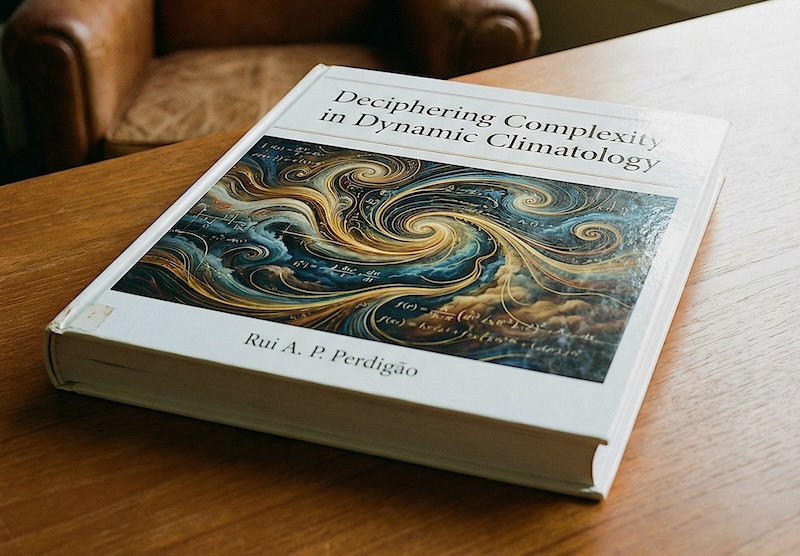
Deciphering Complexity in Dynamic Climatology thus offers more than a survey of climatic phenomena. It is an invitation to rigorous inquiry into one of the most fascinating dynamical systems accessible to science. Through formal analysis, conceptual clarity and systemic vision, the programme seeks to cultivate scholars capable of penetrating the layered structure of climatic complexity and contributing, with intellectual discipline and creative insight, to the scientific and societal challenges of our time.
With thorough scientific depth and broad interdisciplinary breadth, this work now accompanies the author’s namesake academic program headquartered at the Institute for Complex System Science and offered at partner higher education institutions.
Related course materials are made available to enrolled participants in our in-house and affiliated academic programs.
Full Document
Restricted Access: Login here
[This landing page is in construction. More details will ensue soon.]
 Fluid Dynamical Systems